
By Joshua Seemungal
ROOTT Investigations
Read Part One of ROOTT’s investigation into patients’ and families’ concerns.
Documents reviewed by ROOTT Investigations have raised questions about the professional and regulatory status of an 18-month fellowship in gynaecological oncology that Dr Vishal Bahall said he completed at the Northern Ireland Regional Cancer Centre in Belfast.
The Medical Board of Trinidad and Tobago (MBTT) registered Dr Bahall’s Belfast fellowship as an additional qualification in 2024.
That means the fellowship appears among the qualifications recorded by the Board. It does not, by itself, answer whether he is separately recognised as a gynaecological oncology specialist or subspecialist.
The Board has not clarified to ROOTT whether Dr Bahall is separately recognised as a specialist or subspecialist in gynaecological oncology, or whether his specialist registration in Obstetrics and Gynaecology formally authorises him to use the narrower professional description “gynaecological oncologist.”
Obstetrics and Gynaecology is the medical speciality concerned with pregnancy, childbirth and the health of the female reproductive system.
Gynaecological oncology is a more specialised field focused on the diagnosis, treatment and management of cancers affecting that system.
The conventional pathway to recognition as a subspecialist in gynaecological oncology generally involves completing a recognised medical degree, postgraduate specialist training in Obstetrics and Gynaecology and further accredited subspecialty training in gynaecological oncology.
Formal European Society of Gynaecological Oncology (ESGO) fellowship training, for example, generally runs for two to three years. The training and certification requirements of other bodies are assessed under their own rules.
Shorter clinical fellowships may provide genuine advanced training but, by their duration or title alone, do not establish formal subspecialist accreditation.
Former patient Alana Ransome, several patients’ relatives and medical professionals who spoke on condition of anonymity have questioned the accreditation and regulatory status of Dr Bahall’s fellowship and his use of the title “gynaecological oncologist.”
They alleged that, although Dr Bahall completed his basic medical degree and postgraduate training in Obstetrics and Gynaecology and is registered by the MBTT as an OB-GYN specialist, he did not complete formally accredited subspecialty training in gynaecological oncology.
On that basis, they have questioned whether he is entitled to advertise himself as a gynaecological oncologist.
Dr Bahall has denied the allegations, maintaining that he possesses the qualifications necessary to practise in the highly specialised field and to describe himself as a gynaecological oncologist.
He and his attorneys said his training in gynaecological oncology at the Northern Ireland Regional Cancer Centre, within the Belfast Health and Social Care Trust, was genuine, supervised and competency-based. They rejected allegations that he had improperly held himself out as a gynaecological oncologist.
“I did my research part of it. My thing is signed off by Dr Stephen Dobbs (the training supervisor in Northern Ireland) and again, all this hearsay nonsense. I am working in Trinidad and Tobago. People do fellowships, and it’s registered. Training is registered with the Trinidad and Tobago Medical Board,” Dr Bahall said in 2024.
Ransome, a former patient who filed a formal complaint against Dr Bahall with the MBTT in 2025, questioned the accreditation and regulatory status of the fellowship.
She asked the Board to provide evidence of the qualification’s accreditation and regulatory standing, saying clarification was necessary because Dr Bahall had advised her to undergo surgery while presenting himself as a gynaecological oncologist.
In 2022, a medical doctor who requested anonymity submitted a report to the MBTT questioning Dr Bahall’s fellowship.
Responses provided by the Belfast Health and Social Care Trust to Freedom of Information requests submitted by Ransome have added to the uncertainty surrounding the qualification.
ROOTT Investigations sent the MBTT numerous detailed questions seeking clarification of the concerns raised about Dr Bahall’s fellowship, his regulatory status and his use of the title “gynaecological oncologist.”
The Board did not provide substantive answers to those questions. Instead, it supplied a document confirming that Dr Bahall is registered as a medical practitioner and listing the qualifications recorded against his name.
The document did not state whether he is separately registered or formally recognised as a specialist or subspecialist in gynaecological oncology, nor did it clarify the Board’s position on his use of the description “gynaecological oncologist.”
The absence of an answer does not, by itself, establish that his use of the description is prohibited.
Dr Bahall’s Belfast Gynaecological Oncology Fellowship
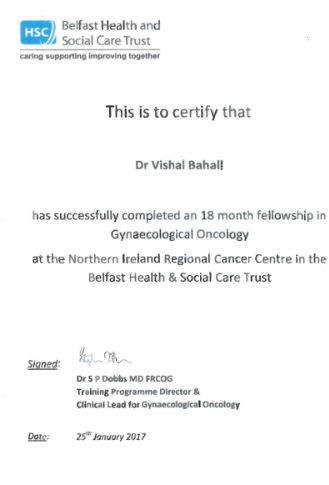
Dr Bahall’s CV lists a subspecialisation in gynaecological oncology and states that he obtained it through an 18-month fellowship at the Northern Ireland Regional Cancer Centre, within the Belfast Health and Social Care Trust.
A certificate dated 25 January 2017 and bearing the Trust’s letterhead states that Dr Bahall “has successfully completed an 18-month fellowship in Gynaecological Oncology” at the cancer centre.
It bears the signature of Dr S.P. Dobbs, identified on the document as Training Programme Director and Clinical Lead for Gynaecological Oncology.
The certificate records the location, duration and completion date of the fellowship.
In other words, it records completion of the training described on the certificate; it does not itself say that a professional training body awarded subspecialist accreditation.
It does not describe the programme as an accredited European Society of Gynaecological Oncology (ESGO) fellowship or state that Dr Bahall received a Royal College of Obstetricians and Gynaecologists (RCOG) Certificate of Subspecialist Accreditation.
The ESGO and RCOG are leading professional organisations that establish recognised training and accreditation standards in gynaecological oncology and women’s reproductive health.
In January 2026, Dr Bahall’s former patient Alana Ransome asked the Belfast Health and Social Care Trust, through a Freedom of Information request:
What is the minimum duration of a fellowship in gynaecological oncology?
If the Trust awards certificates evidencing the completion of such fellowships, could it provide past or present specimens?
The Trust responded, “For the last 10 years, doctors who have trained within gynaecology have done so under formal training programmes. These are either with ESGO or RCOG. The minimum duration of these fellowships is 2 years. If the doctor achieves competency, then the fellowship will be awarded by the training body. Individual trusts do not award any such qualification or certificate.”
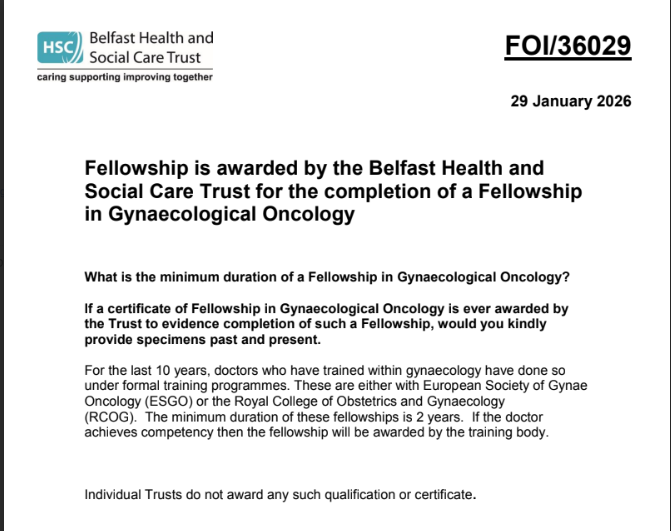
The Trust’s response described the formal ESGO and RCOG training routes and said that individual trusts do not award the resulting qualification or certificate.
It did not determine whether Dr Bahall completed the 18-month clinical training recorded on his certificate, whether that certificate was genuine, or what standing that training had outside those formal accreditation routes.
In a subsequent Freedom of Information request, Ransome asked the Trust:
Whether it awards certificates of completion for 12–18-month training attachments in any subspecialty;
Whether any such training opportunities are regarded as fellowships;
What information would be included on any certificate issued for such training, and whether a specimen could be provided; and
Whether a particular form or form code is used for such certificates.
In September 2026, the Trust said the requested information was exempt from disclosure under the United Kingdom’s Freedom of Information Act 2000, as it was already reasonably accessible to Ransome through its first response.
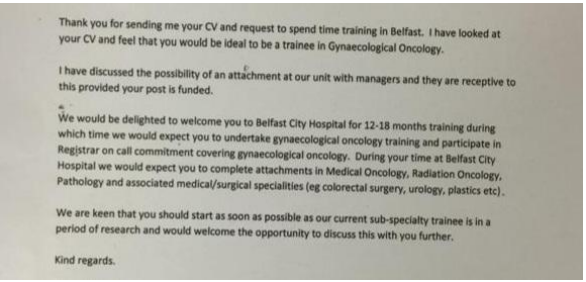
The Trust nevertheless provided an extract from what it described as a visiting-clinician training acceptance letter, which stated, “We would be delighted to welcome you to Belfast City Hospital for 12–18 months training during which time we would expect you to undertake gynaecological oncology training whilst participating in Registrar on call commitment covering gynaecological oncology.”
The extract showed that the Trust offered a 12–18-month placement involving gynaecological oncology training at Belfast City Hospital.
However, it did not identify Dr Bahall, establish that he undertook such a placement, or show that the proposed placement was the fellowship described in his certificate.
It also did not establish what qualification or professional recognition would follow completion of the training.
Asked whether the Belfast Trust certificate was genuine and accurate, Dr Bahall’s attorney Jared Jagroo replied: “Our Client’s position is unequivocal: yes.”
Dr Bahall’s attorneys maintained that the programme was a genuine fellowship and not just visiting clinician training.
Jagroo described the training as “real, supervised and competency-based” and said it included clinical and operative exposure and a structured logbook recording the experience and competencies attained.
Jagroo also argued that the Belfast Health and Social Care Trust’s inability to confer RCOG or ESGO subspecialty accreditation does not mean that personnel within the Trust could not certify a period of fellowship training completed within its service.
Dr Bahall’s attorneys said the two-year requirement for a fellowship by the Belfast Health and Social Care Trust did not contradict Dr Bahall’s 18-month certificate because he never represented his Belfast programme as either the RCOG subspecialty-accreditation route or an ESGO fellowship.
Jagroo said the comparison demonstrated why “the different training and accreditation routes must not be conflated.”
The MBTT Specialist Register and Gynaecological Oncology
The MBTT’s 2026 specialist-registration guidelines do not provide a separate qualification or registration checklist for gynaecological oncology.
The guidelines state that subspecialties within Obstetrics and Gynaecology are not currently recognised through Pathway B. This route assesses specified qualifications, training activities and experience for entry on the Medical Specialist Register.
Put simply, Pathway A is for doctors who have completed a recognised specialist training programme. Pathway B is another route to specialist registration, based on specified qualifications and documented training and work experience. The Medical Specialist Register is the Board’s record of doctors recognised as specialists.
The guidelines took effect on 1 January 2026, after the Board recorded Dr Bahall’s fellowship as an additional qualification in 2024.
Documents reviewed by ROOTT Investigations showed that the MBTT previously recorded gynaecological-oncology qualifications or recognition differently from Dr Bahall’s fellowship.
ROOTT reviewed an MBTT letter stating that another doctor, whose identity has been withheld, was formally recognised by the Board as a gynaecological oncologist.
The letter predated the current Board’s appointment.
ROOTT also reviewed another doctor’s 2026 MBTT registration card, which listed “A Certificate of Subspecialist Accreditation in Gynaecological Oncology” among that doctor’s registered qualifications.
That wording differs from the entry on Dr Bahall’s 2025 registration card, which states “Fellowship in Gynae. Oncology.”
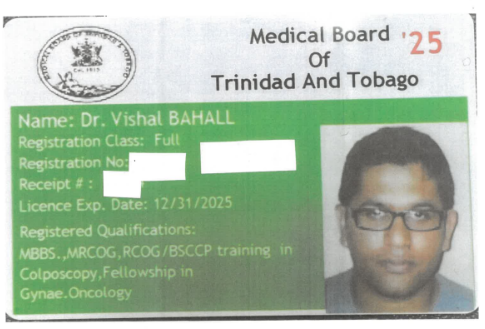
The difference in wording does not, by itself, establish the regulatory standing of either qualification.
It does, however, reinforce the need for the MBTT to clarify whether Dr Bahall is formally recognised as a specialist or subspecialist in gynaecological oncology and the professional descriptions his registration permits him to use.
MBTT Records and Professional Description
In September 2026, ROOTT Investigations sent the MBTT numerous detailed questions seeking clarification on questions posed about Dr Bahall’s Belfast fellowship and his use of the gynaecological oncologist title.
The Board did not provide substantive answers.
Instead, it supplied a document confirming that Dr Bahall is registered as a medical practitioner and listing the qualifications recorded against his name.
When asked about the issues in a 2024 phone call, Dr Ian Ramnarine, head of the MBTT’s Specialist Committee, said that while Dr Bahall was registered as a specialist in Obstetrics and Gynaecology, he was not registered (at the time) as a gynaecological oncologist.
“As far as the council is concerned, Dr Bahall is registered as a specialist in obstetrics and gynaecology. He does gynaecology. He does gynaecological oncology. This is what anybody registered as a specialist in oncology can do.
“The question here is if he’s calling himself something he’s not approved to call himself, and if he is doing that, I would be a bit concerned about that side of things. If he says he has a qualification he does not have, that’s a breach. We do not have gynae-oncology as a recognised subspecialty for pathway B. So unless you are registered as something on the specialist register, you cannot claim something on your CV or on your card and all the rest of it,” he said.
ROOTT Investigations viewed a document bearing the heading ‘From the Desk of Dr Vishal Bahall’ that described Dr Bahall as a Gynaecologist and Gynaecological Oncologist.
Dr Bahall’s private practice company website, as well as third-party professional profiles, media reports and promotional material, have also described him as a gynaecological oncologist.
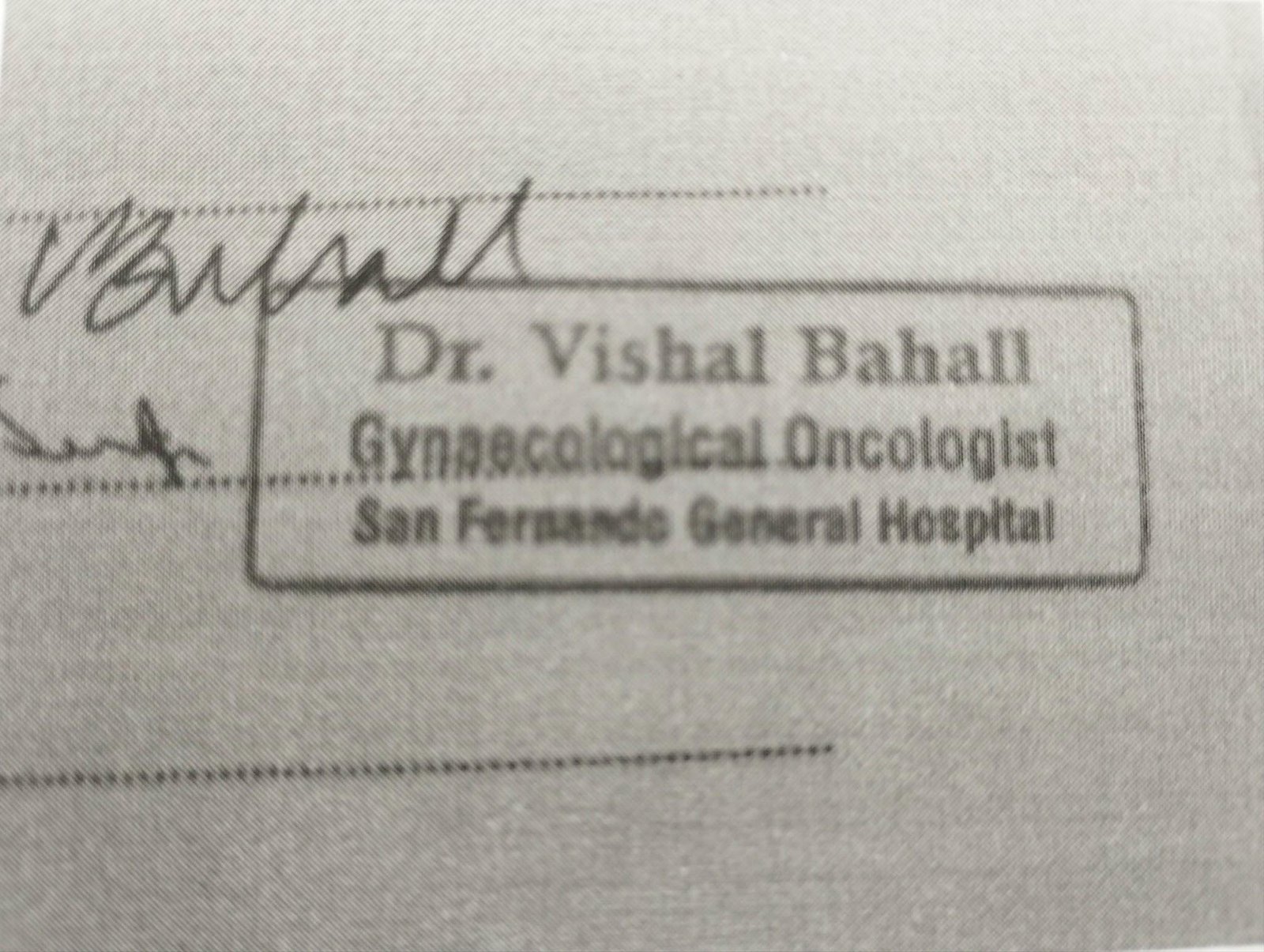
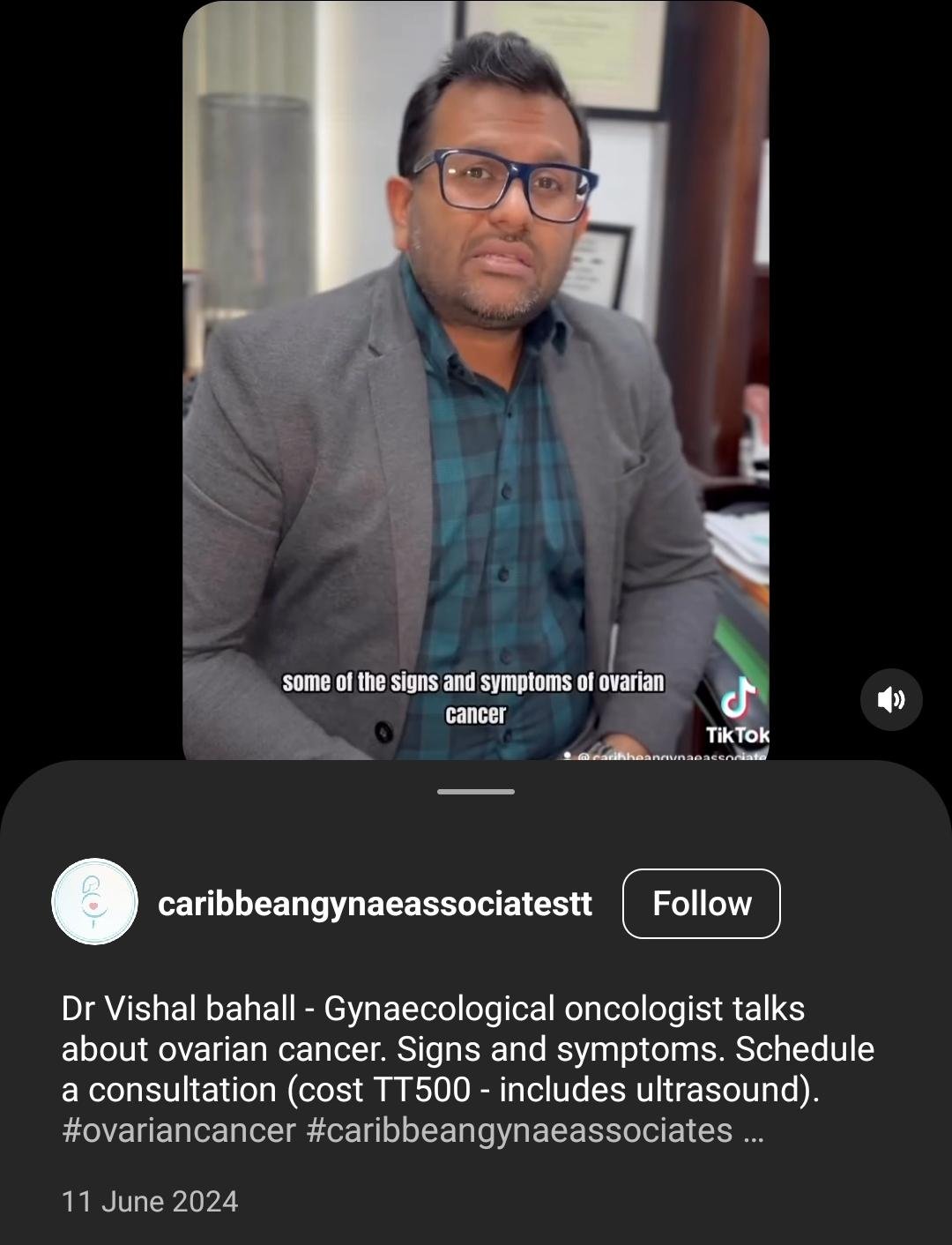
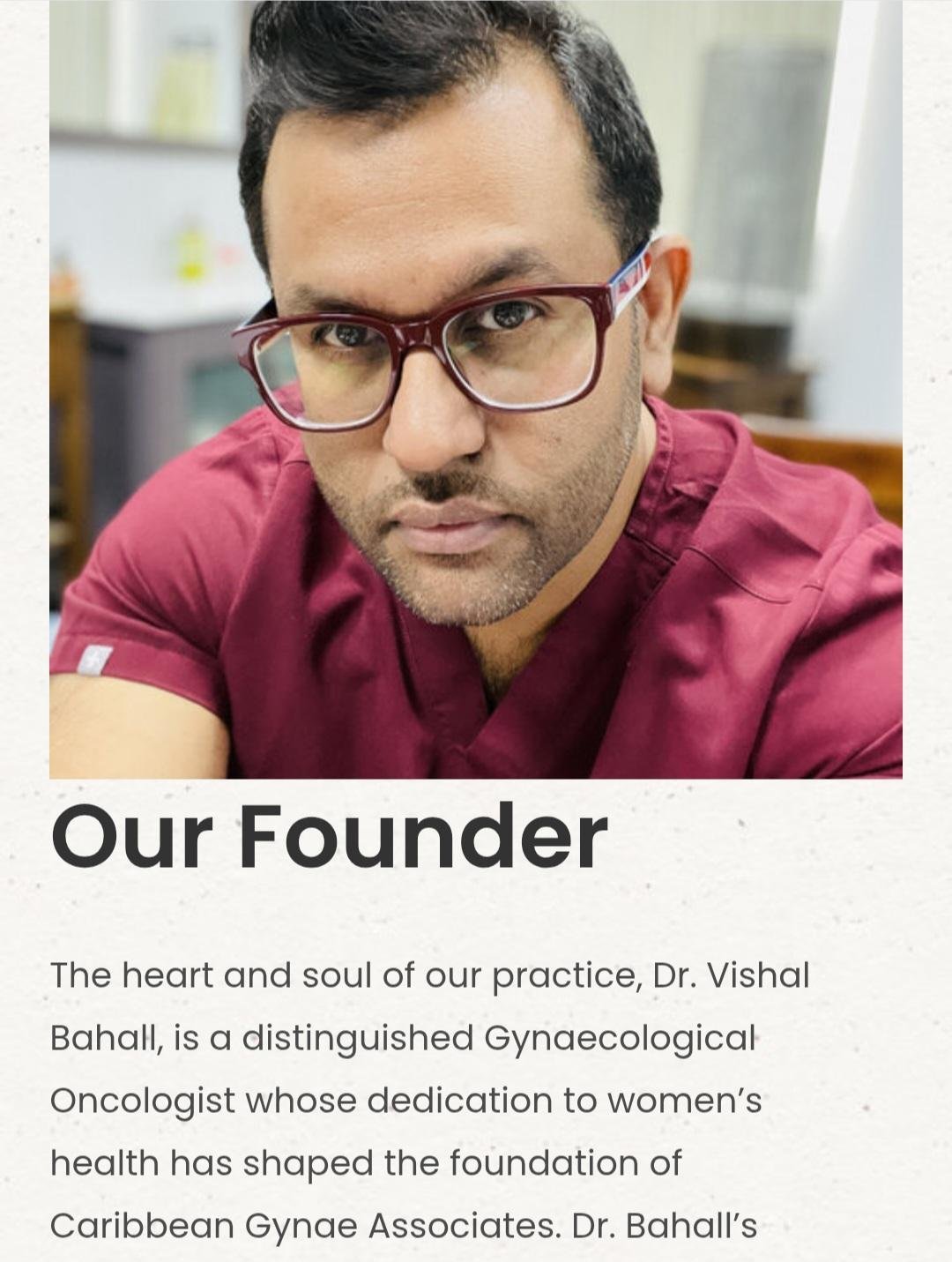
In a letter dated 13 December 2022, the MBTT said it had no record available recognising Dr Bahall as an “Oncologist.”
The letter predates the Board’s recording of his fellowship in gynaecological oncology as an additional qualification in April 2024.
It does not, on its own, establish his present registration status or resolve the Board’s position on his use of the description “gynaecological oncologist.”
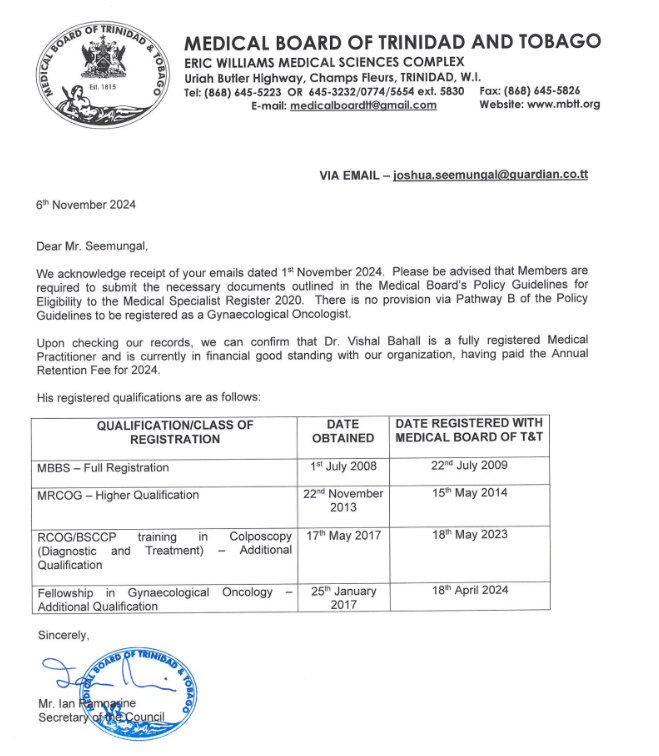
In a subsequent letter, dated 6 November 2024, the MBTT wrote that Dr Bahall registered a fellowship in Gynaecological Oncology on 18 April 2024.
While the letter confirmed that the Board recorded the fellowship as an Additional Qualification, it did not describe the fellowship as specialist or subspecialist registration in Gynaecological Oncology.
It also did not specify his exact entry on the Medical Specialist Register, and it did not answer what regulatory effect that classification carried or whether it formally authorised Bahall to describe himself as a gynaecological oncologist.
ROOTT Investigations asked the MBTT, in September 2026, to confirm whether it agrees with Dr Bahall’s interpretation and whether it has expressly advised him that he may use the description.
In response, MBTT, through Secretary Dr Ian Ramnarine, said, “Kindly refer to our previous correspondence dated 6th November 2024 which provided responses to your inquiries involving Dr Vishal Bahall.”
ROOTT could not identify a provision in the Act that expressly resolves whether registration in Obstetrics and Gynaecology permits this particular professional description. It asked the MBTT for its interpretation, but the Board did not answer.
It also did not provide further answers to other questions by publication time.
In a letter dated 13 September 2026, attorney Jared Jagroo said Dr Bahall “categorically denies any wrongdoing, negligence, professional misconduct, dishonesty, misrepresentation of qualifications or improper clinical conduct.”
Dr Bahall’s attorneys disputed any implication that their client failed to obtain a separately available registration as a gynaecological oncologist from the MBTT.
Jagroo said Trinidad and Tobago does not maintain a distinct specialist-register category called Gynaecological Oncologist and argued that Dr Bahall’s registration in Obstetrics and Gynaecology does not prohibit him from practising within a related subspecialist field.
Dr Bahall’s attorney maintained that his client is entitled to use the description of a gynae-oncologist because it identifies the field in which he trained and practises rather than a separately registered qualification.
“There is a critical difference between describing one’s area of subspecialty practice and falsely claiming to hold a particular statutory registration or external accreditation. Our Client has done the former, not the latter,” Jagroo wrote.
How an ESGO Fellowship Appeared in Public Biographies
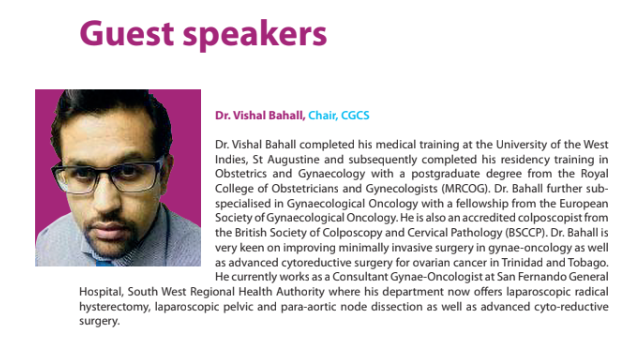
ROOTT Investigations viewed several public biographies of Dr Bahall which listed him as possessing a fellowship in Gynaecological Oncology from ESGO.
A 2019 gynaecological-oncology conference, an RX Rounds promotional graphic, an online professional listing, and a Caribbean Gynaecologic Cancer Society biography all described him as having an ESGO fellowship.
When contacted, one of the publications, which described Dr Bahall as having an ESGO fellowship, said that it (the publication) relies on doctors to fill out professional and personal information.
The owner of the publication shared a completed general document, which it said was filled out by Dr Bahall.
ROOTT has not independently established who created or sent the document.
Bahall’s attorney, Jagroo, acknowledged that descriptions of Dr Bahall as having an ‘ESGO fellowship’ appeared in third-party material but said: “Our Client did not author or supply that description.”
ROOTT has not established who supplied the ESGO fellowship description to each of the other publishers.

Dr Bahall’s Response
In a letter dated 13 September 2026, attorney Jared Jagroo said Dr Bahall “categorically denies any wrongdoing, negligence, professional misconduct, dishonesty, misrepresentation of qualifications or improper clinical conduct.”
On Dr Bahall’s qualifications, Jagroo said four matters must be distinguished: his specialist registration in Trinidad and Tobago, his Belfast fellowship training, formal RCOG subspecialty accreditation and ESGO certification. “One is not a substitute for, or proof of, another,” he wrote.
The letter said Dr Bahall’s recognised specialist registration is in Obstetrics and Gynaecology and described his 18-month Belfast training as “real, supervised and competency-based.” It said the programme included clinical and operative exposure and a structured logbook, and that the supporting documents were submitted to the Medical Board and “recorded as an additional qualification/training credential.”
Jagroo said Dr Bahall had never claimed that the Belfast fellowship resulted in an RCOG Certificate of Subspecialist Accreditation. He also said: “Our Client does not claim to hold an ESGO Fellowship or an ESGO certificate. He has never represented that he was awarded either.”
The attorneys acknowledged that an “ESGO fellowship” description appeared in third-party material but said Dr Bahall “did not author or supply that description.” ROOTT has asked the publishers of that material to identify its source and whether Dr Bahall reviewed or approved it.
Dr Bahall’s attorneys maintain that he may describe the field in which he trained and practises. They said there is “a critical difference between describing one’s area of subspecialty practice and falsely claiming to hold a particular statutory registration or external accreditation.” ROOTT has asked the Medical Board to clarify whether it agrees with that interpretation.